- เกี่ยวกับวิทยาลัย
- การศึกษาและนิสิต
- งานวิจัย
- บริการวิชาการ
- ประชาสัมพันธ์
- English Info.





M Niaz Asadullah and Pataporn Sukontamarn*
ASEAN countries outperform much of developing Asia on several social and gender indicators. Yet the region still wrestles with deep-rooted contradictions. Strong economic growth has not fully eliminated child marriage in Indonesia. Despite impressive educational achievements and high female labor force participation, son preference remains entrenched in Vietnam.
The classic Vietnamese poem Thương vợ (“To My Wife”) by Trần Tế Xương portrays a woman’s devotion, sacrifice, and endurance — virtues that, for centuries, defined womanhood through the lens of service and suffering. Today, Vietnamese women can pursue education, careers, and leadership roles, but the social imagination still lags. Women in literature continue to be described as caring and selfless rather than independent or ambitious. Changing these cultural narratives is as crucial as closing gender gaps in schools and workplaces.
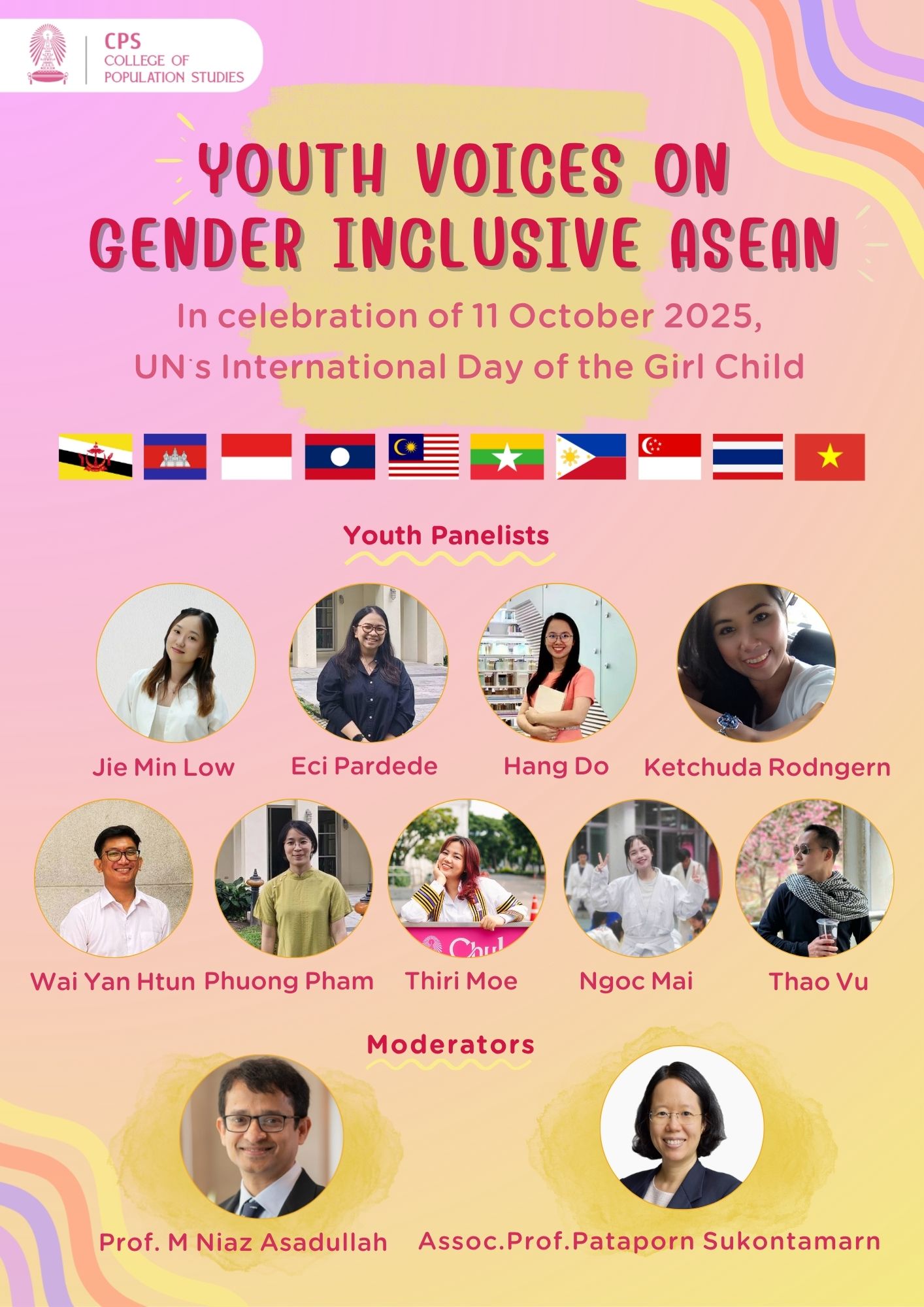
In celebration of the International Day of the Girl Child, we spoke with ASEAN students at Chulalongkorn University’s College of Population Studies about their hopes for a more gender-equal region. Their reflections offer valuable lessons for policymakers and advocates alike. Four themes stood out for us.
1. Collaboration and Empowerment
The students called for stronger partnerships between governments and NGOs to identify effective models of empowerment.
2. Gender Mainstreaming in Higher Education
ASEAN’s universities, the students argued, must harness the region’s youth as stakeholders in gender reform. For this, integrating gender perspectives into graduate training is essential. “Gender research helps reveal hidden stereotypes and social patterns that often go unnoticed in everyday life,” said Phuong Pham. Building a connected youth research community can lay the groundwork for future gender-inclusive policy thinking in ASEAN.
3. Recognizing Overlooked Vulnerabilities
For Wai Yan Htun of Myanmar, gender equality cannot be separated from the context of conflict and fragility. Ethnic communities in conflict-affected regions face unique challenges as young girls balance caregiving duties with their own education. With state institutions weakened, grassroots groups such as the Women’s League of Burma and the Kachin Women’s Association are essential lifelines. Thiri Moe, also from Myanmar, pointed to UNICEF’s girls-only classrooms in Rohingya refugee camps as an example of inclusive support. These voices remind us that ASEAN’s commitment to gender equity must extend beyond national borders and include communities living through crisis.
4. Shifting Mindsets Through Education
Cultural change begins early — in the stories children read and the heroes they learn to admire. The students agreed that ASEAN’s textbooks should feature more women leaders and reformers.
Early education that includes such role models can reshape attitudes toward girls’ rights, aspirations, and social value—offering a subtle but powerful path toward lasting gender equality.
Toward a Gender-Inclusive ASEAN
The voices of ASEAN’s youth are clear: empowerment requires collaboration, inclusion, and imagination. Policies alone are not enough. Change must reach classrooms, community programs, and cultural narratives alike.
On this International Day of the Girl Child, we are reminded that gender equality in ASEAN is not a distant goal—it is a collective responsibility. Governments must partner with schools, media, and civil society to nurture a generation that not only demands equality but redefines it.
As these students reminded me, the future of ASEAN will be written not only in policy papers but also in the stories, classrooms, and everyday courage of its girls.
Acknowledgements: We would like to thank Abel Asfaw Kebede, Eci Pardede, Hang Do, Jie Min Low, Ketshuda Rodngern, Nazia Yusuf Hussain, Ngoc Mai, Phuong Pham, Rungtip Lertnithus, Thao Vu, Thet Wai Thwe, Thiri Moe, Wai Yan Htun, and Zhijie Zeng for sharing their thoughts and ideas with us.
---------------------------------
*M Niaz Asadullah is an Adjunct Professor, and Pataporn Sukontamarn is Associate Dean, College of Population Studies, Chulalongkorn University.